India Tech Salary Benchmarks: What Top Talent Actually Earns in 2026


If you're hiring in India in 2026 and still pricing offers off a 2023 spreadsheet, you're not being conservative. You're being invisible.
The India tech salary benchmarks for 2026 have moved faster than most global TA leaders realise and the movement is uneven. AI/ML has shot up. App Dev is steady but stratified. Network and Infrastructure has crept up quietly. Finance & Operations roles inside GCCs have become the most competitively priced segment in the country.
Our experience for over the last 12 years.. we`ve placed 15,000+ candidates across 150+ organisations ..12,000+ full-time, 3,000+ contingent. Bengaluru accounts for 73.5% of those placements, with strong volumes also out of Delhi/NCR, Mumbai, Pune, Hyderabad, and Chennai. That gives us a current, real view of what offers are landing not just what platforms are advertising.
Here's what top India tech talent actually earns in 2026, by domain, city, and experience.
App Dev & Testing: Steady, But Senior Roles Have Re-Rated
App Dev & Testing is still the largest hiring segment we work in about 34% of our placements. The base of the market hasn't moved much. The top has.
For a Tier-1 city in 2026 (Bengaluru, Hyderabad, Pune):
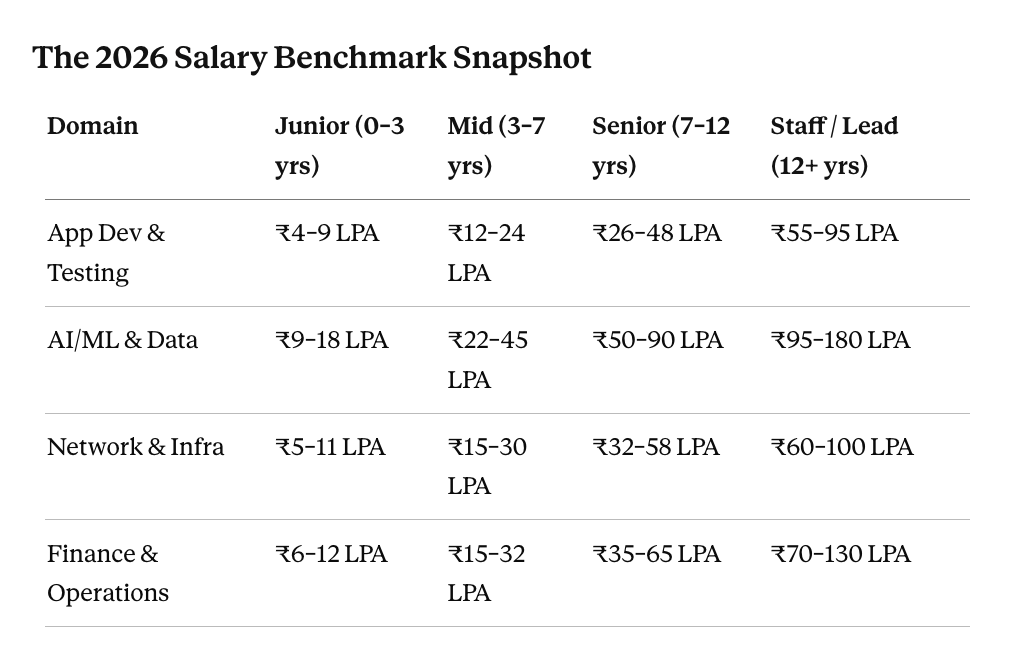
- Junior engineer (0–3 yrs): ₹4–9 LPA
- Mid-level engineer (3–7 yrs): ₹12–24 LPA
- Senior engineer (7–12 yrs): ₹26–48 LPA
- Staff / Principal engineer (12+ yrs): ₹55–95 LPA
The story sits in that staff/principal band. Five years ago, this layer barely existed in India GCCs. Today, every serious global engineering org is building it here and the candidates who can run a tech vertical with minimal supervision are commanding offers that would have been considered US-equivalent in 2022.
If your offer at the 10-year mark still starts with a "2," you're not in the market. You're in the resume bin.
AI/ML and Data: The Premium Tier Has Detached From Everything Else
AI/ML and Data is 21% of what we place and it's the segment where the gap between "market" and "best in market" is widest.
For Tier-1 cities in 2026:
- Junior data/ML engineer (0–3 yrs): ₹9–18 LPA
- Mid-level ML engineer (3–7 yrs): ₹22–45 LPA
- Senior ML engineer / Applied scientist (7–12 yrs): ₹50–90 LPA
- Staff ML / Research lead (12+ yrs): ₹95–180 LPA
The drivers are the obvious ones: GenAI build-outs, AI platform teams inside every BFSI and pharma GCC, and a small pool of candidates who have shipped real LLM systems in production. We've seen offers cross ₹2 crore for the right Staff/Principal candidate this year and those candidates were screening 3–5 competing offers, not negotiating one.
If you're hiring AI/ML in India in 2026 and benchmarking off median data, you'll lose every candidate worth hiring. This is a top-decile market.
Network & Infrastructure: The Quietly Expensive Segment
Network & Infra is 31% of our placements second only to App Dev and it's the segment most people under-price because it doesn't make headlines.
For Tier-1 cities in 2026:
- Junior infra engineer (0–3 yrs): ₹5–11 LPA
- Mid-level (3–7 yrs): ₹15–30 LPA
- Senior infra / SRE (7–12 yrs): ₹32–58 LPA
- Staff / Principal infra (12+ yrs): ₹60–100 LPA
The rise here is being driven by cloud platform consolidation, the SRE-isation of operations roles, and security infra hiring inside regulated GCCs (banking, pharma, insurance). A senior SRE who can run multi-region production is now priced like a senior backend engineer which wasn't true even three years ago.
If you've still got "infra" in your second hiring tier mentally, refresh the model.
Finance & Operations: The GCC Sweet Spot
Finance & Operations is 14% of our placements, and it's where India 2026 quietly offers the best value-to-quality ratio in the world.
For Tier-1 cities in 2026:
- Analyst (0–3 yrs): ₹6–12 LPA
- Mid-level (3–7 yrs): ₹15–32 LPA
- Senior / Manager (7–12 yrs): ₹35–65 LPA
- Director / VP-track (12+ yrs): ₹70–130 LPA
Why this matters: the global cost of an equivalent FP&A, controllership, or operations leader sits 3–5x these numbers. The talent depth in India for this segment particularly out of CA, CFA, and big-4 alumni networks is now a genuine reason to set up a GCC, not a side-effect of one.
The "30–50 LPA range" question we get every week from clients usually maps here, and at that band in Tier-1, you can hire genuinely senior, English-fluent, GCC-experienced operators who have already led 20+ person teams.
Tier-2 City Rates: 15–25% Lower, Sometimes Sharper Talent
We're seeing more clients ask for Tier-2 builds in 2026 Coimbatore, Indore, Ahmedabad, Kochi, Jaipur, Chandigarh.
The rule of thumb: salaries land 15–25% below Tier-1 for the same band. So a senior engineer who'd cost ₹40 LPA in Bengaluru lands at ₹30–34 LPA in Coimbatore or Indore.
But the discount isn't the whole story. Tier-2 candidates are often less mobile, more loyal, and less prone to the 6-month attrition cycle that punishes Bengaluru hiring. Lower offer, longer tenure, lower total cost of hire over 24 months.
The trade-off: shallower senior pools. If you need 2 staff engineers in Indore, you'll find them. If you need 20, your Tier-1 plan has to stay alive.
The 2026 Salary Benchmark Snapshot
What ₹30–50 LPA Actually Buys You in 2026
Clients ask us this all the time, so plainly:
At ₹30–50 LPA in a Tier-1 city, in 2026, you can hire:
- A senior backend or platform engineer with 8–11 years and real ownership experience.
- A mid-to-senior ML engineer who has shipped production models but probably not a GenAI specialist.
- A senior SRE who's run multi-region infra at scale.
- A genuinely senior operations or finance manager who can lead a 15–25 person team.
What ₹30–50 LPA does not buy you in 2026: a Staff GenAI engineer, a Principal architect at a top-tier product company, or a VP-track operator with GCC build experience. Those are 1.5–3x bands.
If your offer band is fixed and the role is at the edge, the question isn't "can we negotiate harder?" The question is "are we briefing for the right level?" That's a scoping problem, not a budget problem.
How nexocean Keeps Clients Competitive
Three things drive most offer mistakes in India in 2026: stale benchmarks, generic JDs, and slow decision cycles. We solve all three.
Our Wingman platform Atlas for benchmarking, Blaze for role intelligence, Terra for performance, Zephyr for communication gives clients real-time compensation views by city, domain, experience, and even competitor company. That's how we run hiring cycles 20–40% faster than market standard, and how 97% of Waves event candidates report high satisfaction with our process.
We don't quote ranges from a static report. We quote what offers are landing, this week, for the role you're hiring.
If you're scaling a team in India in 2026 and want a compensation read on your open roles or a benchmark before you launch talk to us at nexocean.com. We'll give you the honest number, not the comfortable one.
#BuildingOceanofTalents #EnablingTeamsfromIndia

Related News


The Leadership Pipeline Trap: Why Automating Entry-Level Roles Now Costs You Leaders Later
The most overlooked finding in 2026's talent research: cut the bottom of your org chart to save on cost, and you quietly cut off your future leaders. India offers a way out.

Founder & Head of Partnerships
Start building
your team.
From first call to operational pod in 45 days. Here's how we start.
Discovery Call (45 mins)
Custom roadmap (48 Hours)
After our call, you'll receive:

