Diversity Hiring in India: What the Data Actually Shows


Diversity Hiring in India: What the Data Actually Shows
Most D&I hiring conversations in India start with a target. They rarely start with a question: why isn't the pipeline getting there?
After 15,000+ placements across 150+ organizations — including some of the most globally recognised companies operating in India — we've seen the same patterns repeat. The ambition is real. The execution consistently breaks in the same three places.
This is what the data shows.
The Honest State of Diversity Hiring in Indian Tech Today
India's tech sector has made genuine progress on gender diversity in entry-level and mid-level roles. But the numbers fall off sharply in senior roles, niche domains, and across dimensions beyond gender — disability, LGBTQ+ inclusion, socioeconomic background.
Most companies operating in India — GCCs, product companies, IT services firms — have a D&I policy. Far fewer have a D&I hiring process.
The policy sets a number. The process determines whether you reach it. And in our experience, the process is where things quietly fall apart.
The Pipeline Problem Nobody Talks About
Here's the uncomfortable truth: most D&I sourcing fails before the interview ever happens.
The sourcing brief is written with a standard candidate profile in mind. JDs use language that filters implicitly. Interview panels aren't briefed on structured evaluation. And when the shortlist comes back without enough diversity, the conclusion drawn is usually "the talent isn't there" — rather than "our sourcing approach didn't reach the right people."
The pipeline problem is real. But it's mostly a created problem, not an inevitable one.
At NexOcean, we've found that the gap between diverse candidates in the market and diverse candidates in a shortlist is almost always a briefing and sourcing gap — not a supply gap. The talent exists. The process isn't finding it.
What NexOcean's Placement Data Actually Shows
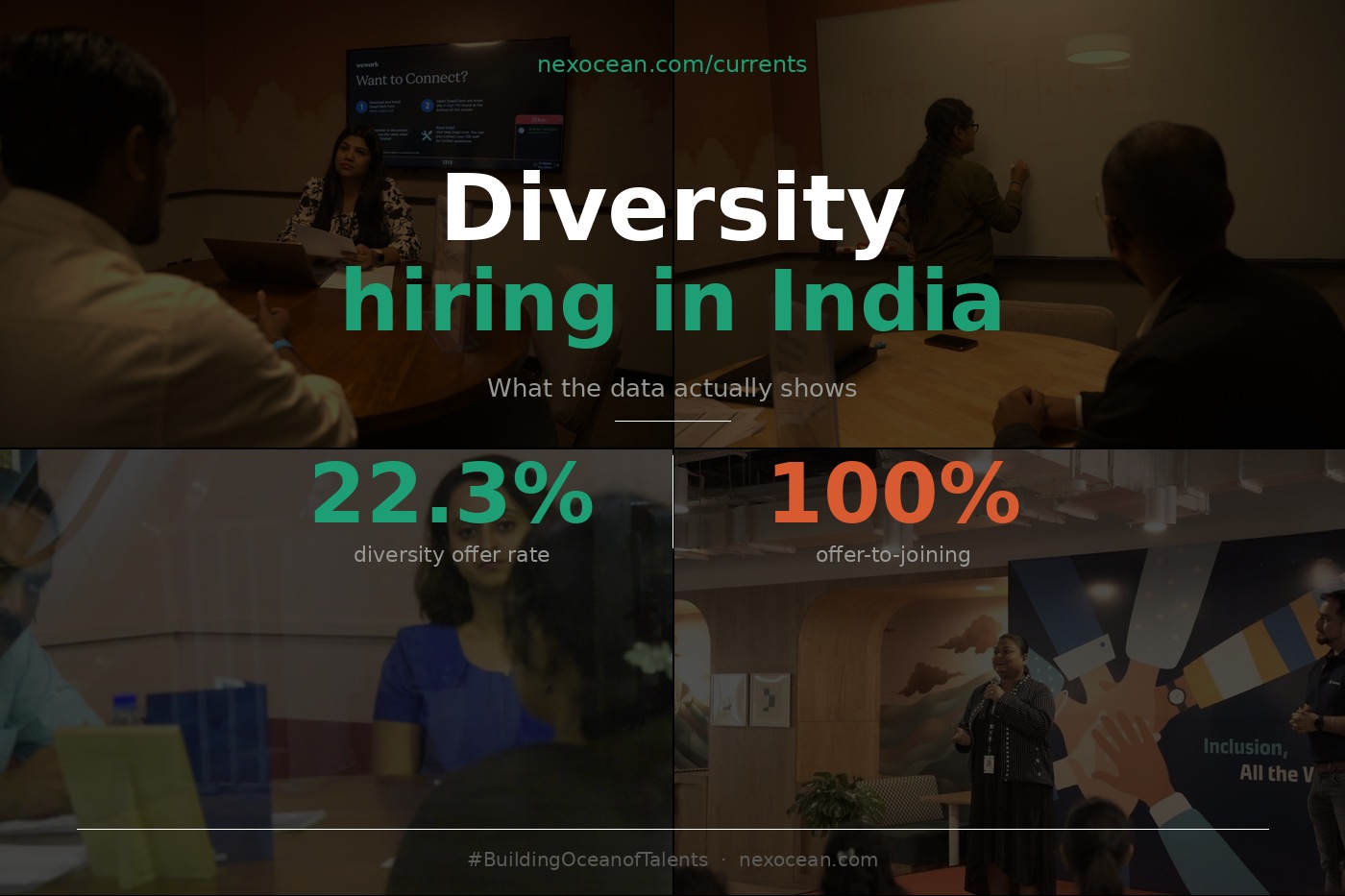
Across our placements, we've consistently achieved a 22.3% diversity offer rate. In a market where many organisations struggle to reach double digits on diverse shortlists, that number reflects something structural — not accidental.
What drove it:
Intentional sourcing, not add-on sourcing. Diversity sourcing has to be built into the search from the start, not bolted on after the primary shortlist comes back thin. This means proactive outreach to communities, rewriting JDs for inclusive language, and actively challenging the default definition of "the right profile."
Structured briefing conversations. Before we start any search, we align with the hiring manager on what the role actually requires — not what's historically been hired. This surfaces hidden filters that screen out strong candidates early.
Evaluation calibration. We brief interviewers on what to look for, and flag when subjective gut-feel is doing work that a structured question should be doing.
None of this is complicated. All of it requires commitment.
What 100% Offer-to-Joining in Our Diversity Cohort Took
The number that surprised even us: 100% offer-to-joining rate in our diversity cohort.
In a market where offer drops are a known pain point — especially for candidates who receive multiple offers simultaneously — this didn't happen by chance.
A few things we do consistently that made the difference:
Candidate narrative, not just candidate screening. When we understand why someone wants this role, what they're moving toward and not just away from, their commitment to the offer is much more predictable.
Post-offer engagement that's genuine, not transactional. A 48-hour offer with no follow-up communication is a common reason candidates stay warm to counter-offers. We stay engaged — not to pressure, but because the transition period is when doubt enters.
Ensuring the candidate's India story is answered. For many diverse candidates — particularly women returning to tech, or candidates from Tier-2 cities — there are specific questions about flexibility, team culture, and growth path. If those aren't addressed before joining, the offer gap widens.
[INTERNAL LINK: candidate psychology and employer brand — suggested anchor: "what candidates check before accepting an offer"]
What D&I Monitoring Actually Looks Like in Practice
A diversity dashboard that reports a number at quarter-end isn't D&I monitoring. It's D&I reporting — which is useful, but not the same thing.
Real D&I monitoring in hiring means tracking drop-off points in the funnel: where are diverse candidates exiting the process? At JD stage (impressions vs. applications)? At screening? At interview? At offer?
Each dropout point has a different cause and a different fix. Without funnel visibility, you're treating a stage-three problem with a stage-one intervention and wondering why the number doesn't move.
For organisations scaling GCC teams in India, this kind of funnel monitoring is especially important. Hiring at speed and hiring inclusively aren't in conflict — but they require deliberate process design, not just good intent.
Five Moves for Companies Starting D&I Hiring in India
If you're building an India team and want D&I to be real rather than performative, here's where to start:
1. Audit your JDs for exclusionary language before you post. Tools exist. More importantly, read it out loud and ask: who does this describe? If it sounds like it was written about a specific person, it probably was.
2. Source proactively, not reactively. Don't wait for diverse candidates to apply. Go where they are — alumni networks, returning-professional communities, coding communities with strong diversity representation, Tier-2 city campuses.
3. Brief your hiring managers, not just your recruiters. The recruiter brings diverse candidates to the shortlist. The hiring manager decides the outcome. If the manager isn't briefed on structured evaluation, the process breaks at the final stage.
4. Measure funnel, not just outcome. Track diversity at every stage — not just in the offer. Know where candidates drop out. That data tells you where to intervene.
5. Close the loop with candidates who don't get the role. One of the most underrated employer brand moves in India: a respectful, specific decline note. Candidates talk. India's tech talent community is smaller than it looks.
The Bottom Line
Diversity hiring in India isn't a pipeline problem. It's mostly a process problem.
The talent is here. The 22.3% diversity offer rate and 100% offer-to-joining we've achieved across thousands of placements isn't the product of a unique market advantage — it's the product of a deliberate approach to sourcing, briefing, evaluation, and post-offer engagement.
If your D&I numbers in India aren't where they should be, the answer probably isn't "there aren't enough diverse candidates." The answer is almost certainly upstream from the interview.
We've helped 150+ organisations build and scale tech teams in India, including some of the world's most recognisable brands. If diversity hiring is a challenge you're wrestling with, let's talk.
nexocean.com | #BuildingOceanofTalents

Related News
The Leadership Pipeline Trap: Why Automating Entry-Level Roles Now Costs You Leaders Later
The most overlooked finding in 2026's talent research: cut the bottom of your org chart to save on cost, and you quietly cut off your future leaders. India offers a way out.

Founder & Head of Partnerships
Start building
your team.
From first call to operational pod in 45 days. Here's how we start.
Discovery Call (45 mins)
Custom roadmap (48 Hours)
After our call, you'll receive:

